Most physics starts with space, time, and particles.
VERSF starts one step earlier—with a more basic question:
What must exist for anything to be distinguishable at all?
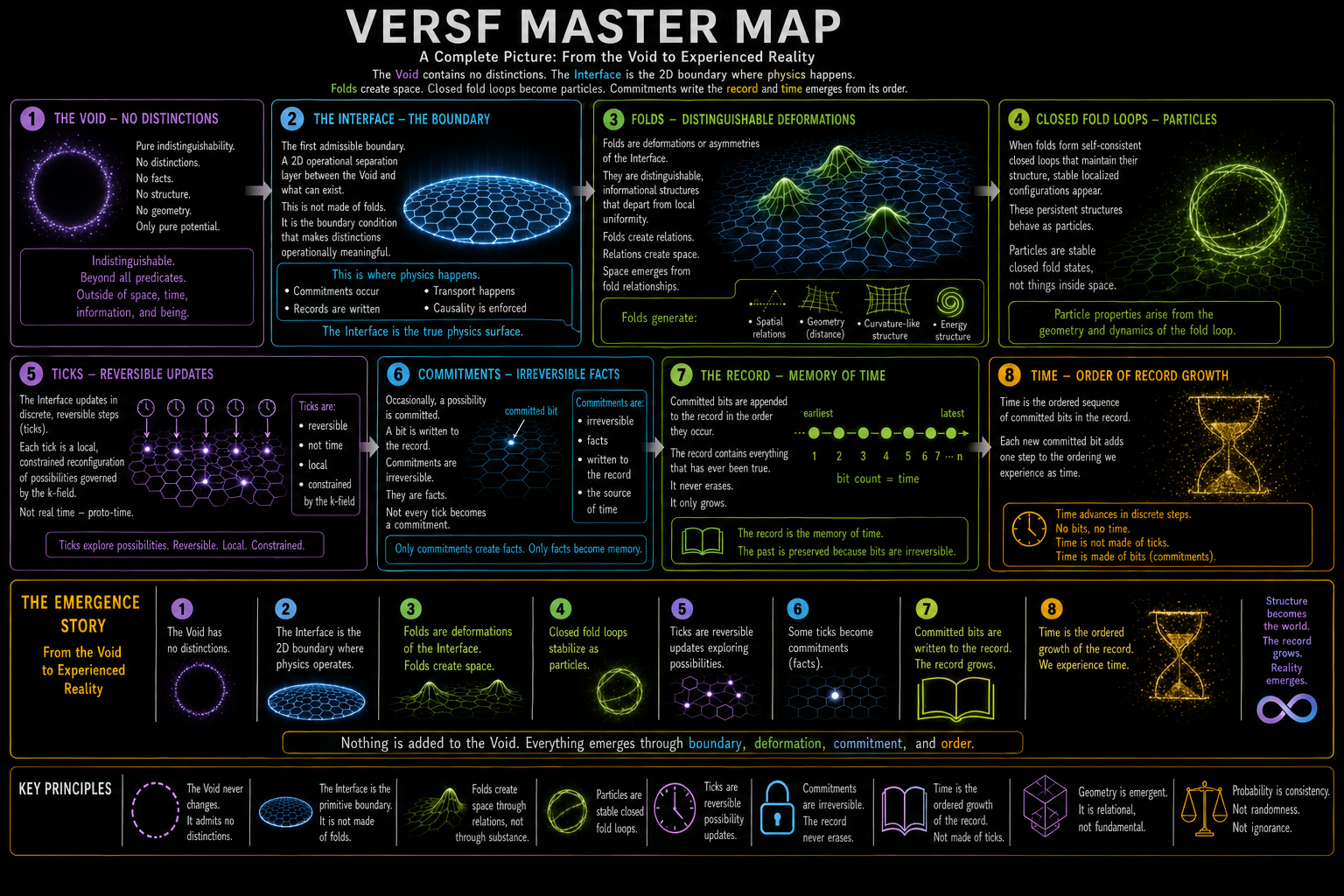
The visual maps below show how reality can emerge from that starting point. They are not separate ideas, but different views of a single structure. Each visual map explores one part of this system in more detail. Together, they form a single picture: how a world with time, space, and structure can emerge from nothing more than distinguishability and irreversible change.
The Core Idea
At the heart of VERSF is a simple shift:
Reality is not made of objects in space.
It is the growing record of irreversible distinctions.
Everything else—time, geometry, distance, probability—emerges from how that record forms and evolves.
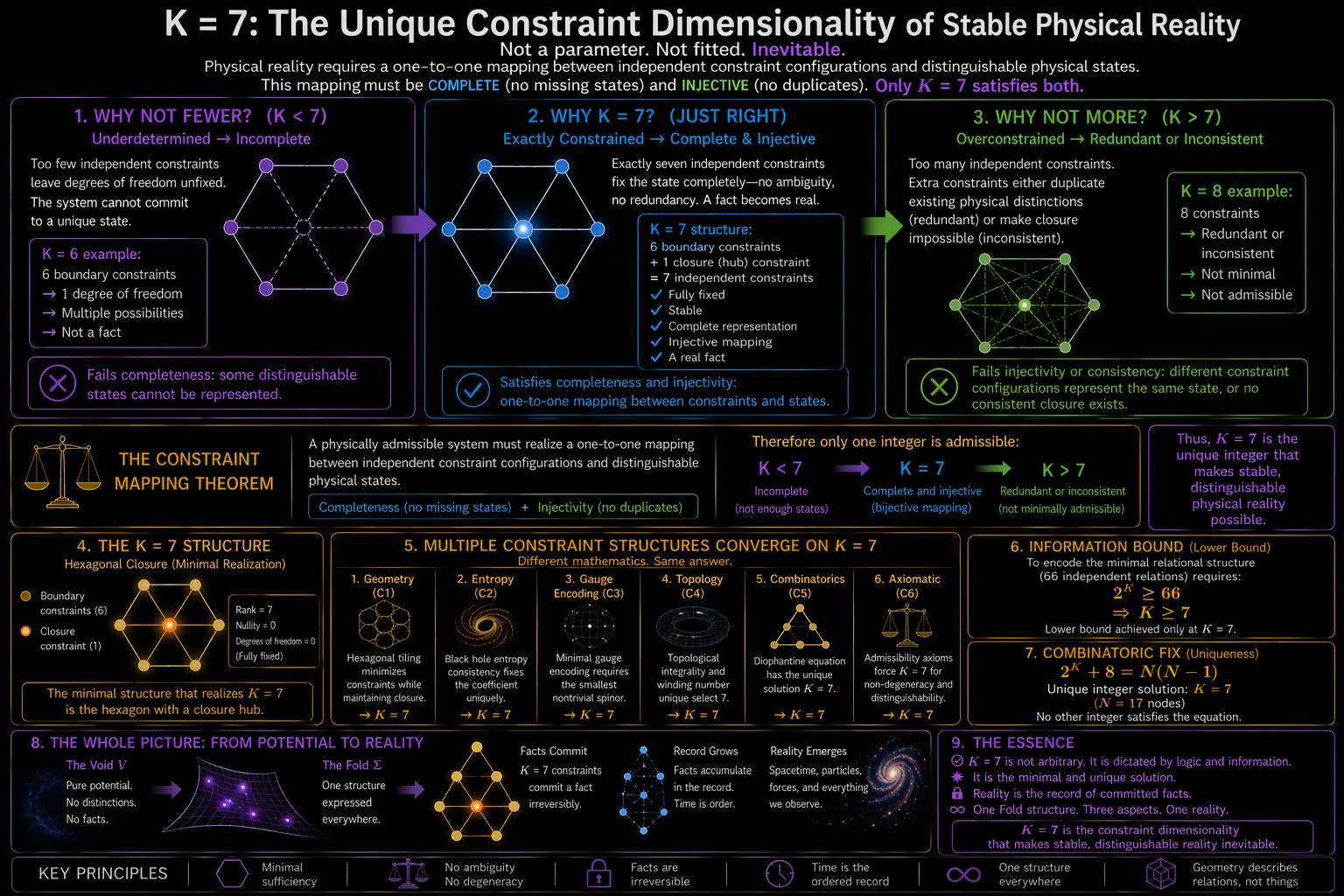
1. The Void and the Fold
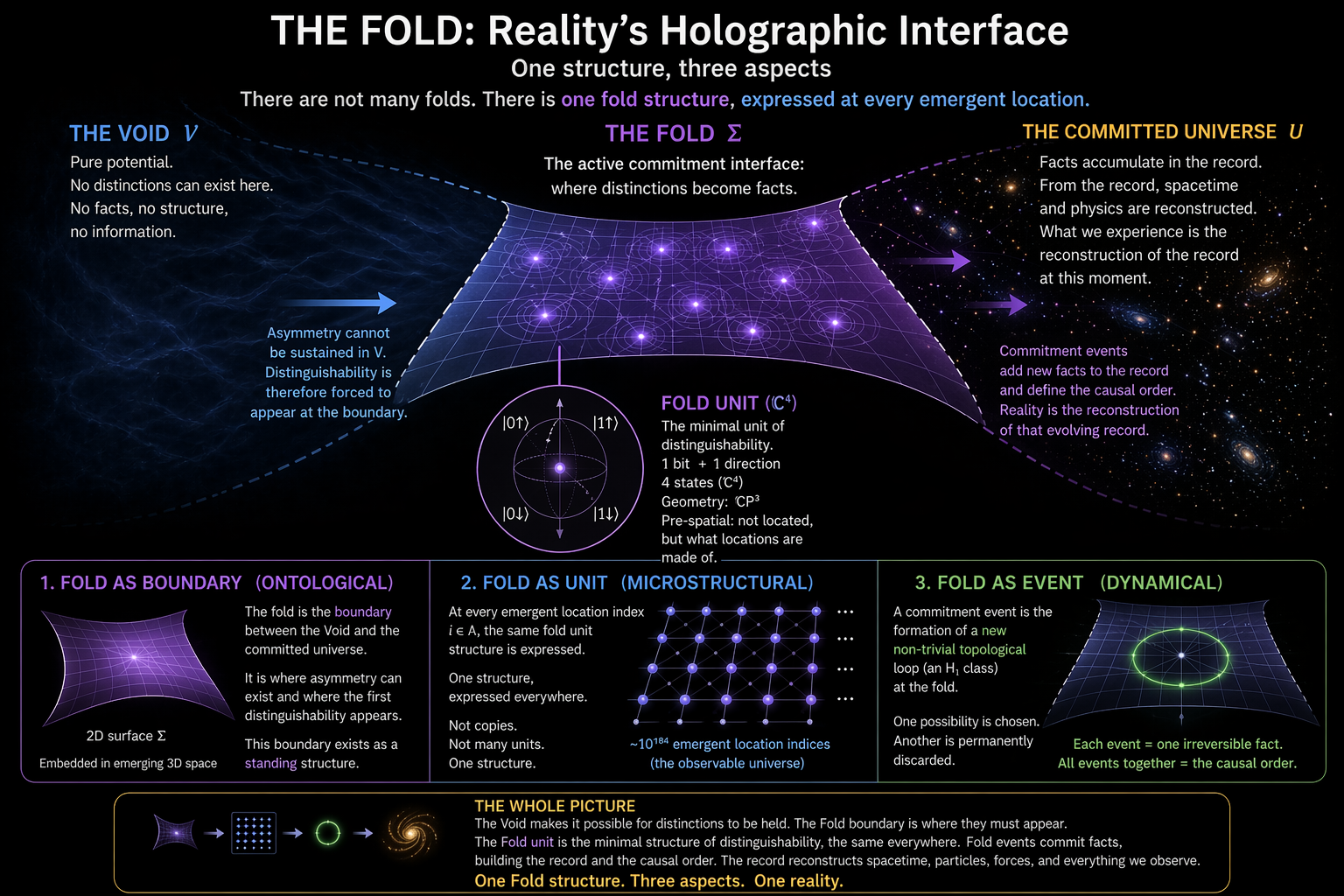
The starting point is the Void:
- No distinctions
- No facts
- No structure
- Only pure potential
Nothing can exist within the Void, because nothing can be distinguished from anything else.
For anything to happen, a boundary is required.
This boundary is the Fold.
- It is not a place in space
- It is the condition under which distinctions can occur
- It is where possibility becomes commitment
There are not many folds. There is one fold structure, expressed everywhere a distinction becomes real. This follows from minimality: if distinguishability requires a boundary, the simplest consistent structure is a single universal interface, not many independent ones.
2. Ticks and Commitments
Near the Fold, reversible updates occur. These are called ticks:
- They are local
- They are reversible
- They explore possibilities
Most ticks do not become real.
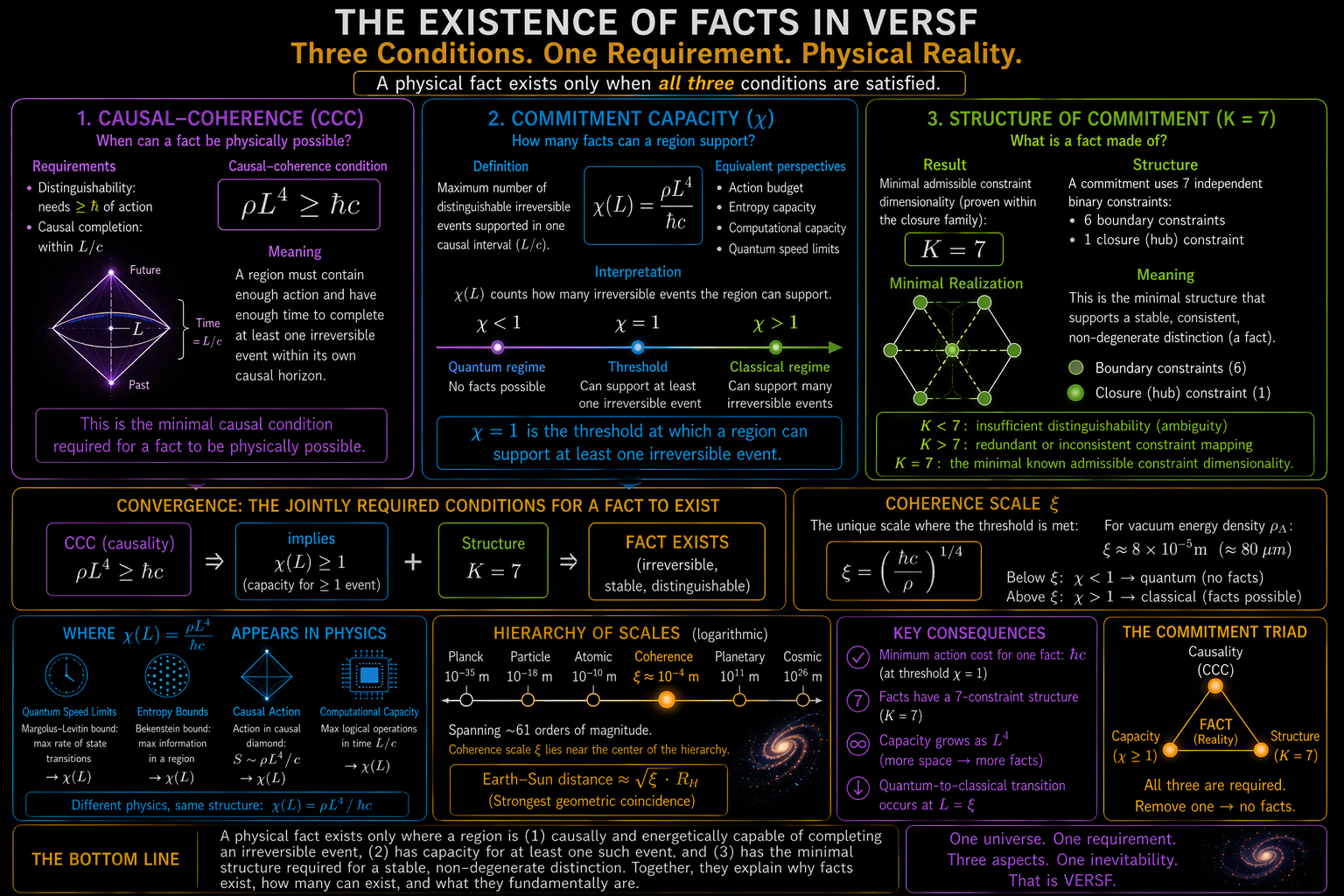
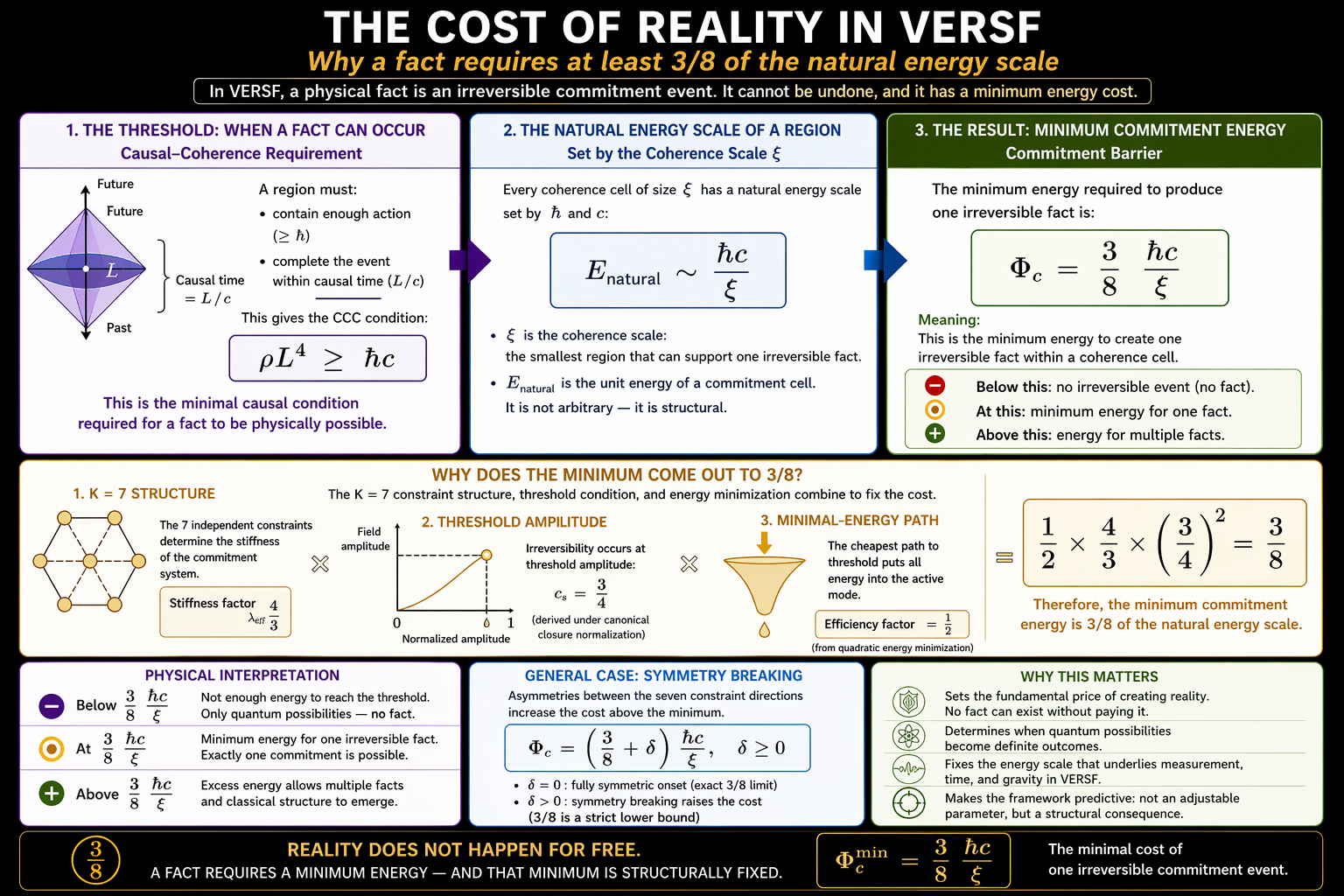
A commitment is different:
- One possibility is selected
- A bit is written
- The change becomes irreversible
A commitment is a fact.
This is the moment where reality begins to form.
3. The Record: Memory of Everything
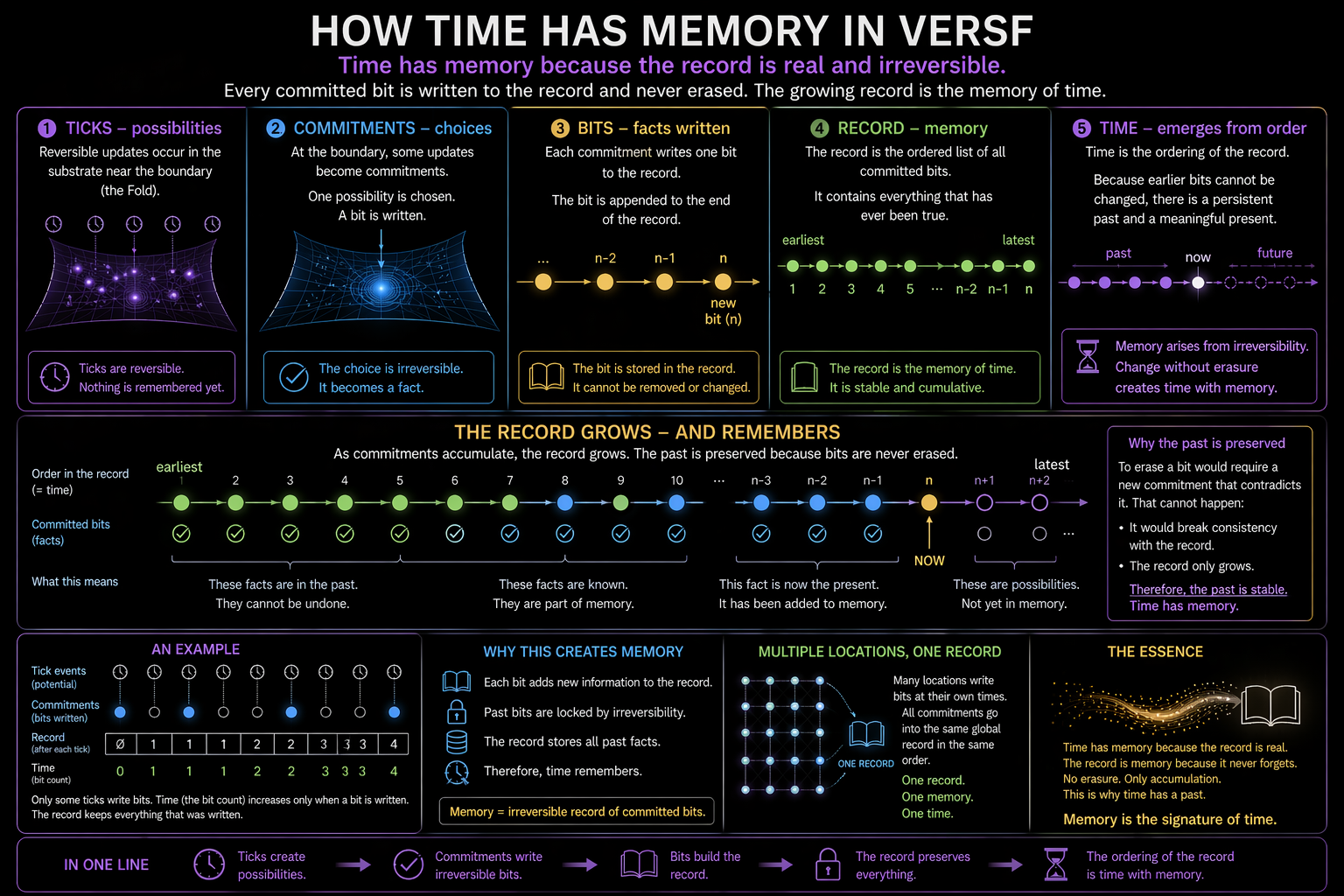
Each commitment writes a bit to a growing structure: the record.
- It never erases
- It only grows
- It contains everything that has ever been committed
The record is the memory of reality.
This is critical:
- The past is preserved because it cannot be undone
- Every new fact is added, never replaced
4. Time: Not a Dimension, but a Count
Time is not something separate from the record.
Time is the ordering of committed bits.
- Each commitment adds one step
- No commitments → no time
- Time advances only when facts are created
This is why time has memory:
- The record stores all past commitments
- Irreversibility prevents erasure
- The past is stable because it is recorded
5. Information and Relations
Committed bits are not isolated.
They constrain one another and form relations.
These relations create information structure:
- What is possible depends on what has already been committed
- The record becomes internally structured
At this stage, there is still no geometry—only structured information.
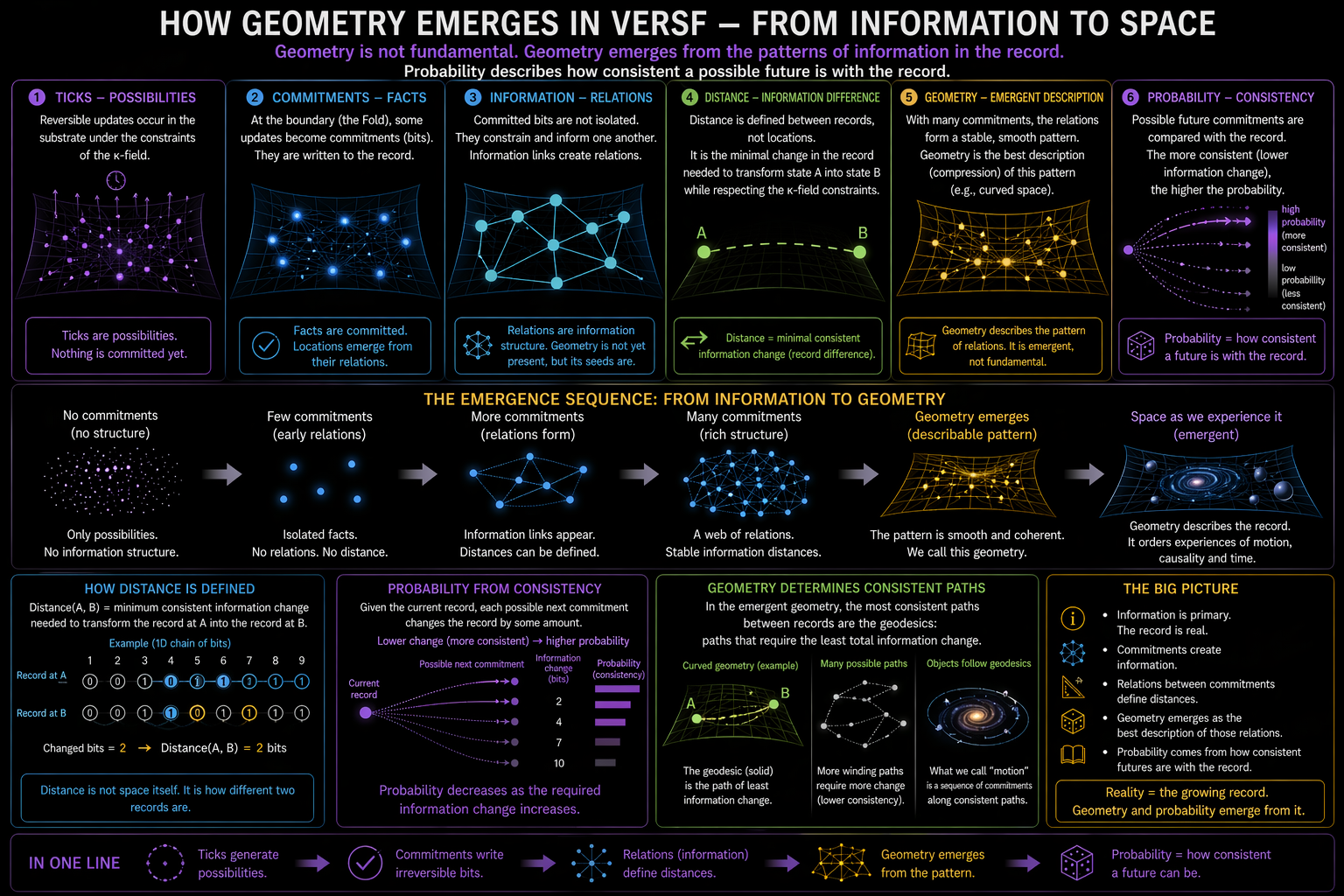
6. Distance: Information Difference
Distance is not defined between points in space.
Instead:
Distance is the minimum consistent information change between records.
To move from state A to state B:
- Some bits must change
- The smallest consistent change defines the distance
This introduces a key constraint:
The Role of the k-field
All transformations are constrained by the k-field.
- The k-field defines which transitions are allowed
- It enforces consistency with the existing record
- It limits how information can change locally
You can think of it as:
The rule-set that ensures new commitments do not contradict what already exists.
This prevents arbitrary jumps and ensures structured evolution.
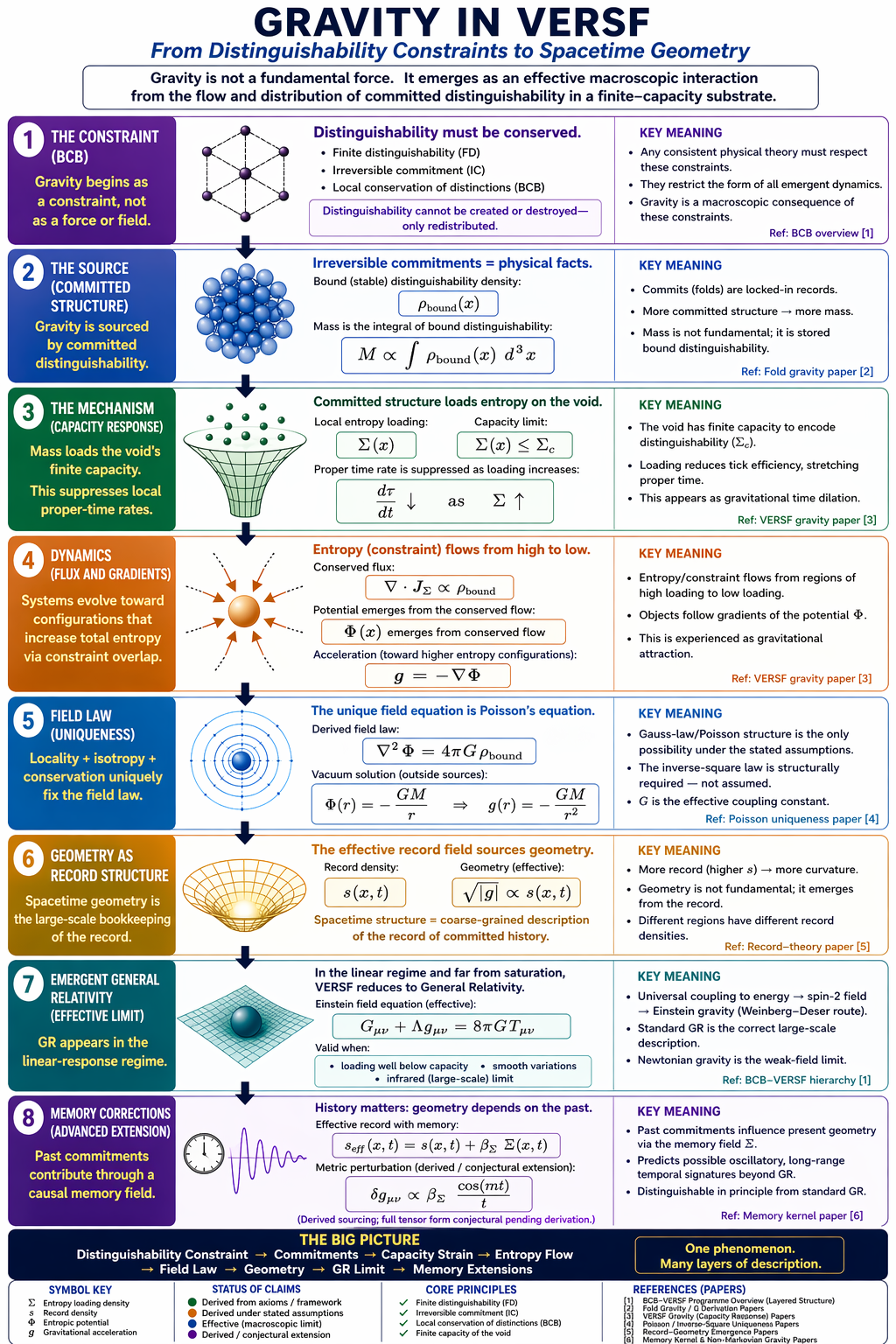
7. Geometry: An Emergent Description
With many commitments, the network of relations becomes large and structured.
At this point:
Geometry emerges as the best description (compression) of that structure.
- It does not exist independently
- It is a way of summarising patterns in the record
Why does it look continuous?
Because:
Paths that minimise information change cluster into smooth, stable structures.
These clusters behave like continuous manifolds.
This is what we experience as space.
8. Motion and Paths
In this emergent geometry:
- The most consistent transitions define preferred paths
- These are the paths of least information change
These are what we call geodesics.
Objects do not “move through space” in a fundamental sense.
Instead:
They follow sequences of commitments that minimise change in the record.
9. Probability: Consistency, Not Randomness
Future possibilities are evaluated against the current record.
Probability measures how consistent a possible future is with what already exists.
- Low information change → high consistency → higher probability
- High information change → lower consistency → lower probability
This gives probability a structural meaning:
It is not randomness—it is compatibility with the record.
Putting It All Together
The sequence is:
- No distinctions (Void)
- Distinctions become possible (Fold)
- Possibilities explored (ticks)
- Facts created (commitments)
- Facts stored (record)
- Order emerges (time)
- Relations form (information)
- Differences define structure (distance)
- Structure compresses (geometry)
- Futures evaluated (probability)
Why This Matters
If this picture is correct, then:
- Time is not fundamental
- Space is not fundamental
- Geometry is not fundamental
Instead:
They are emergent properties of an irreversible informational process.
Reality is not built from objects in space.
It is built from commitments that accumulate into structure.
In One Line
Possibilities become commitments.
Commitments build the record.
The record becomes reality.