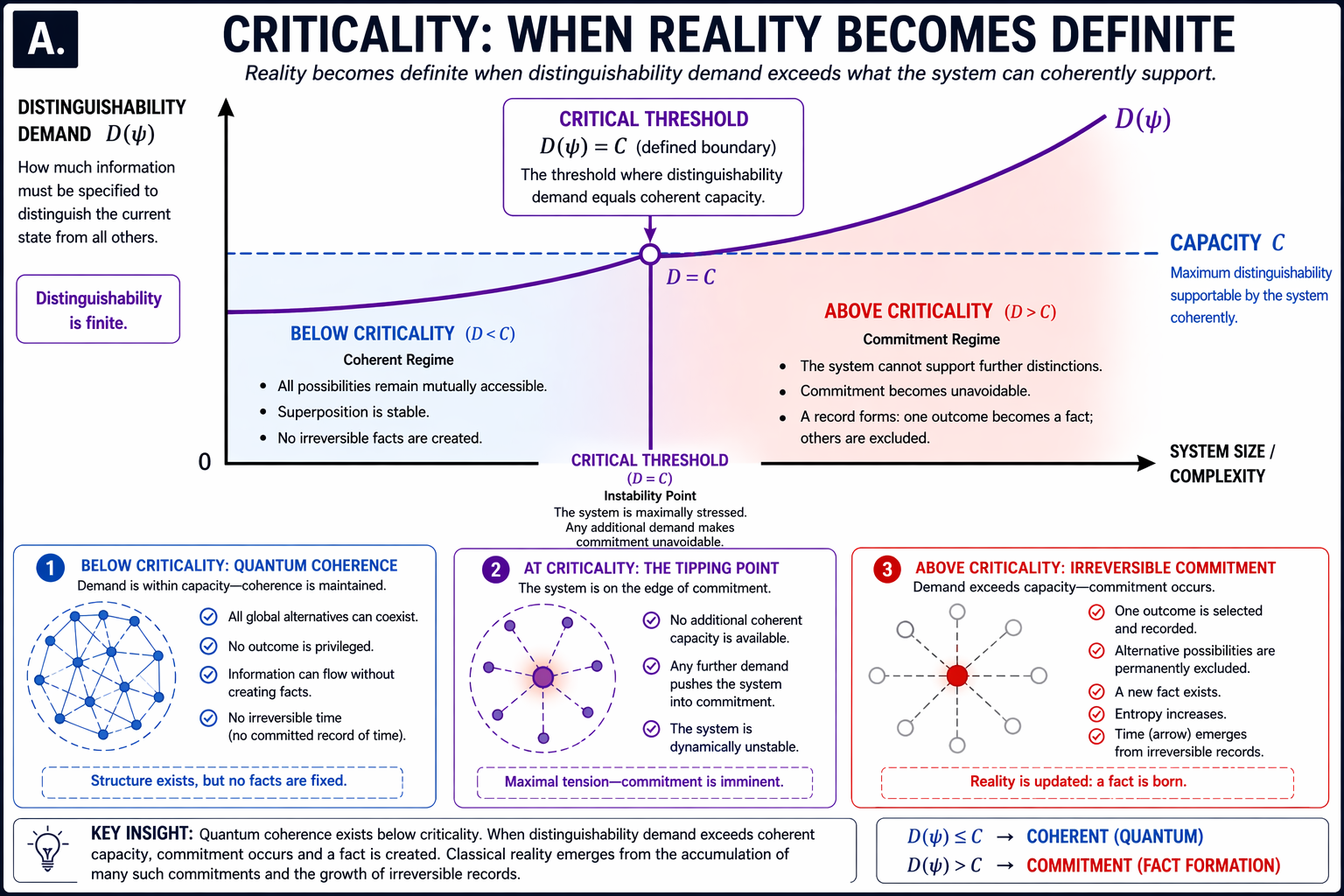
This visual isolates one of the most important ideas in the VERSF framework: reality does not become definite continuously—it becomes definite at a threshold.
At the heart of the diagram is a simple but powerful relationship between two quantities. On one side is distinguishability demand, D(ψ)—how much information is required to uniquely specify the current state of a system among all alternatives. On the other is coherent capacity, C—the maximum distinguishability the system can support while remaining fully coherent. As long as D(ψ)≤C, the system can sustain superposition: multiple possibilities coexist, interfere, and evolve without producing definite outcomes. This is the familiar quantum regime.
But this situation cannot persist indefinitely.
The Threshold Where Reality Becomes Definite
The key insight is that there exists a precise structural boundary:D(ψ)=C
This is not an approximate or emergent condition—it is a defined threshold. At this point, the system is maximally loaded. It cannot support any additional distinguishability without losing coherence. The diagram makes this explicit by anchoring the critical point as the intersection of demand and capacity—a fixed boundary rather than a vague transition.
Once the system crosses this threshold (D(ψ)>C), something fundamental happens:
Commitment becomes unavoidable.
This is the moment where one possibility becomes a fact. A stable, irreversible record is formed, alternatives are excluded, and entropy increases. In VERSF, this is not described as a mysterious “collapse,” but as irreversible commitment—the physical process by which possibility becomes reality.
Quantum Coherence and the Absence of Facts
Below the threshold, the system behaves in a way that is deeply non-classical but entirely consistent. All possible configurations remain accessible. No outcome is privileged, and no irreversible record is formed. Importantly, this does not mean “nothing is happening.” The system is evolving, interfering, and exploring possibilities—but it has not yet produced a fact.
This is why quantum mechanics looks so strange from a classical perspective. We are observing systems before commitment, in a regime where reality has not yet been fixed. Superposition is not a paradox—it is what a system looks like when it remains within its coherent capacity.
Commitment and the Emergence of the Classical World
Above the threshold, the picture changes completely. The system can no longer sustain all alternatives simultaneously. A selection is made—not because of an external observer or a special collapse mechanism, but because the system itself cannot support further distinctions coherently.
This produces:
- A definite outcome
- A stable record
- An increase in entropy
- The emergence of an arrow of time
Classical reality, in this view, is not fundamental. It is the result of many such commitment events accumulating over time. What we experience as a stable, definite world is built from these irreversible transitions.
The Deeper Message
The most important takeaway from this visual is that the boundary between quantum and classical is not arbitrary. It is not about measurement devices, observers, or interpretation. It is a structural limit imposed by the finite capacity of any system capable of producing facts.
Quantum coherence exists because the system has room to sustain possibilities.
Classical reality appears when it no longer does.
One-Line Summary
👉 Reality becomes definite not because something “collapses,” but because distinguishability demand exceeds what the system can coherently support.