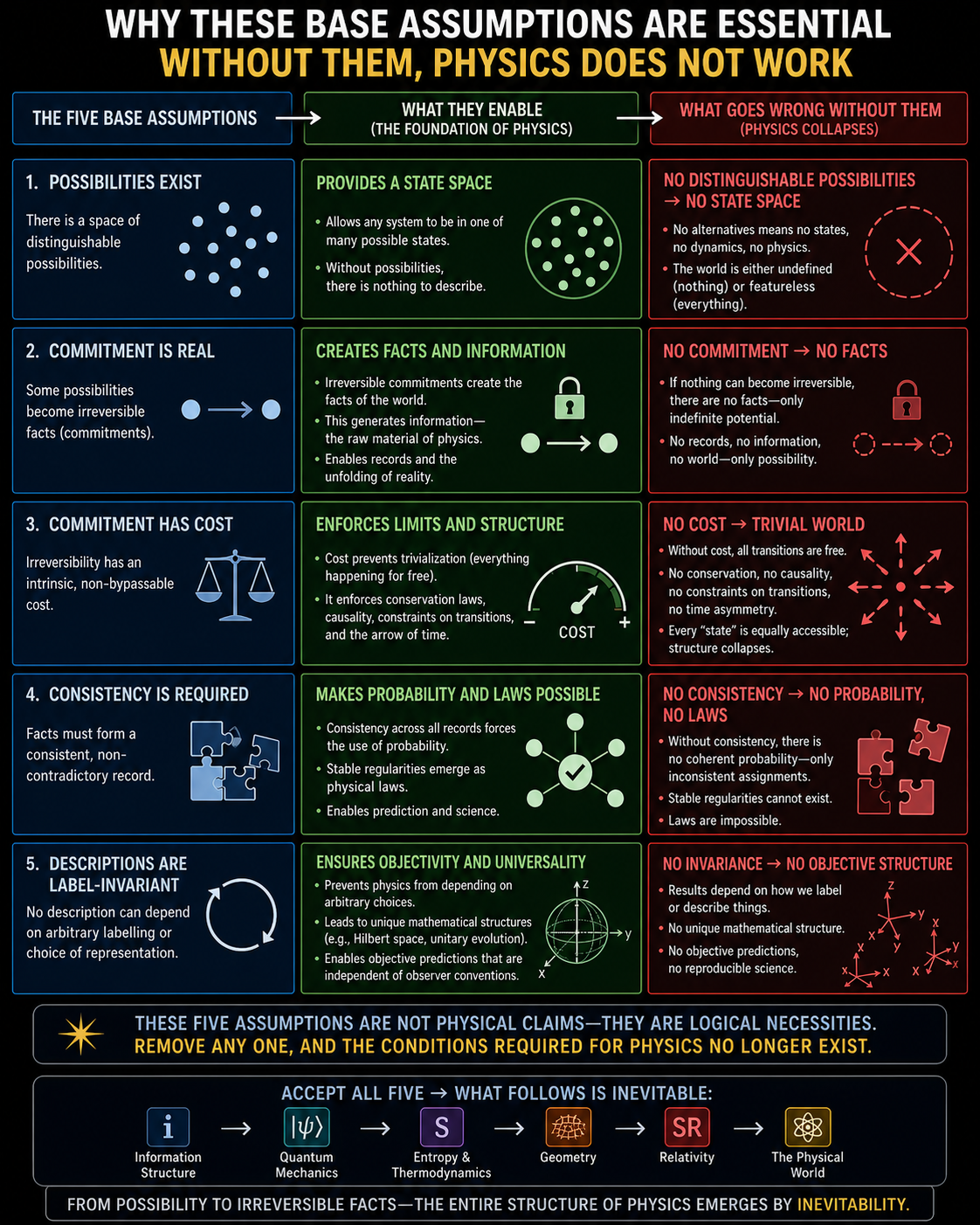
At the deepest level, physics isn’t really about particles or forces—it’s about what can exist, what can happen, and what becomes real. The five assumptions in your diagram are basically the minimum rules needed for any meaningful “world” to exist at all. If you remove even one of them, you don’t just get a different kind of physics—you get no physics whatsoever.
Start with the first idea: possibilities must exist. If there are no distinguishable alternatives—no “this vs that”—then there’s nothing to describe. No states, no change, no dynamics. It’s like trying to tell a story with no characters and no events. Physics begins the moment there are different things that could happen.
The second step is that some possibilities actually become real. This is what your diagram calls “commitment.” At some point, one option gets selected and becomes a fact. Without this, everything just stays in a fog of potential forever—nothing ever truly happens. Reality would be a kind of permanent “maybe,” with no actual outcomes.
But for those commitments to matter, they need to come with a cost. If switching between possibilities were completely free, then nothing would be stable. Everything could change instantly, without constraint. By introducing a cost, you get structure: conservation laws, causality, and the arrow of time. This is what stops the universe from collapsing into chaos.
Next comes consistency. Once facts are created, they can’t contradict each other. If they did, you couldn’t build reliable patterns, and without patterns, you can’t have laws of physics. Consistency is what allows probability to make sense and lets us predict what might happen next based on what’s already happened.
Finally, the way we describe things shouldn’t matter. Whether you use one coordinate system or another, or label things differently, the underlying physics should stay the same. This is what gives us objectivity. Without it, reality would depend on perspective in a fundamental way, and science would lose its footing.
What your diagram is really saying is this:
These aren’t just nice ideas—they’re the bare minimum requirements for a universe that makes sense.
And once you accept all five, something remarkable happens. You don’t have infinite freedom to build any kind of physics you like. Instead, the structure starts to lock itself into place. Concepts like quantum mechanics, entropy, and even spacetime geometry begin to emerge not as arbitrary choices, but as the only consistent way the system can work.
That’s the punchline:
Physics doesn’t look the way it does by accident.
Given these basic conditions, it may be the only way it could look.