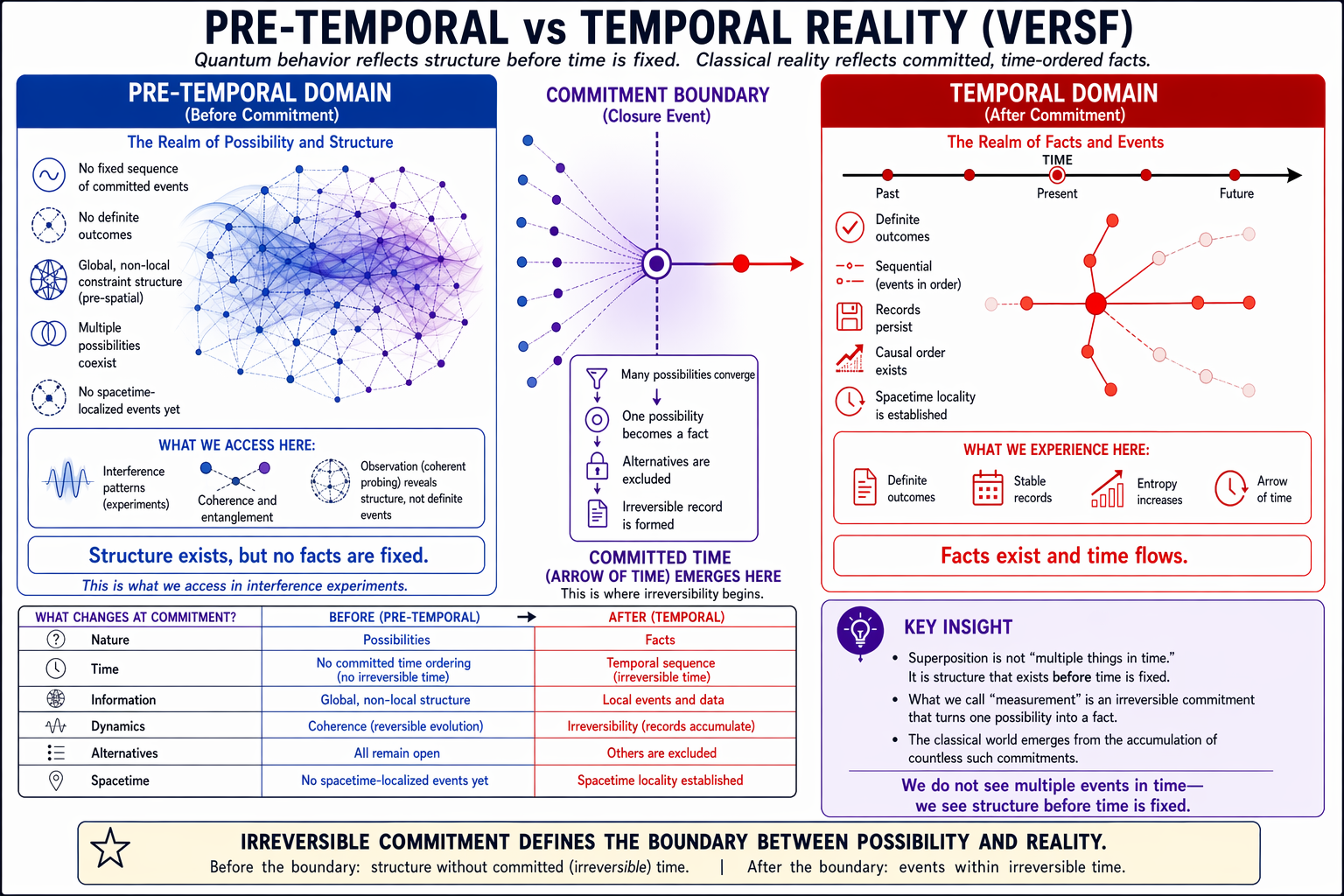
This visual captures one of the most important ideas in the VERSF framework: not everything we observe belongs to the same layer of reality. What we call “quantum” and “classical” are not just different behaviors—they correspond to different regimes of structure.
On the left side is the pre-temporal domain. Here, systems exist as structured sets of possibilities. There are no definite outcomes, no fixed sequence of events, and no committed records. Instead, there is a global constraint structure in which multiple possibilities coexist. This is the regime we access in interference experiments. When we observe superposition, we are not seeing multiple events unfolding in time—we are probing a system whose structure has not yet been fixed into time at all.
The Boundary Where Reality Forms
At the center of the visual is the commitment boundary. This is the point where a system can no longer remain in a purely coherent, reversible state. A single outcome is selected, alternatives are excluded, and a stable record is formed.
This is not a mysterious “collapse.” It is an irreversible commitment—a physical process in which information becomes fixed. The key insight is that time, in the sense we experience it, emerges here. Before commitment, there is no irreversible ordering of events. After commitment, there is.
The Emergence of Time
On the right side is the temporal domain—the world we are familiar with. Here, outcomes are definite, records persist, and events occur in sequence. This is where causality, memory, and the arrow of time all make sense.
But in this framework, time is not fundamental. It is not a background stage on which physics plays out. Instead, it is a result of commitment. Each irreversible event contributes to a growing record, and from that record emerges the ordered flow we call time.
What Changes at Commitment
The transition across the boundary is not subtle—it is structural:
- Possibilities become facts
- No committed time becomes a temporal sequence
- Global structure becomes localized events
- Reversible dynamics becomes irreversible history
This is why quantum systems appear so strange: they are not behaving “weirdly in time”—they are being observed before time has been fixed by commitment.
The Key Insight
The visual makes a simple but powerful point:
We do not see multiple events in time—we see structure before time is fixed.
Superposition is not a paradox. It is what reality looks like before it becomes definite.
One-line takeaway
👉 Irreversible commitment defines the boundary between possibility and reality—and it is at that boundary that time itself emerges.