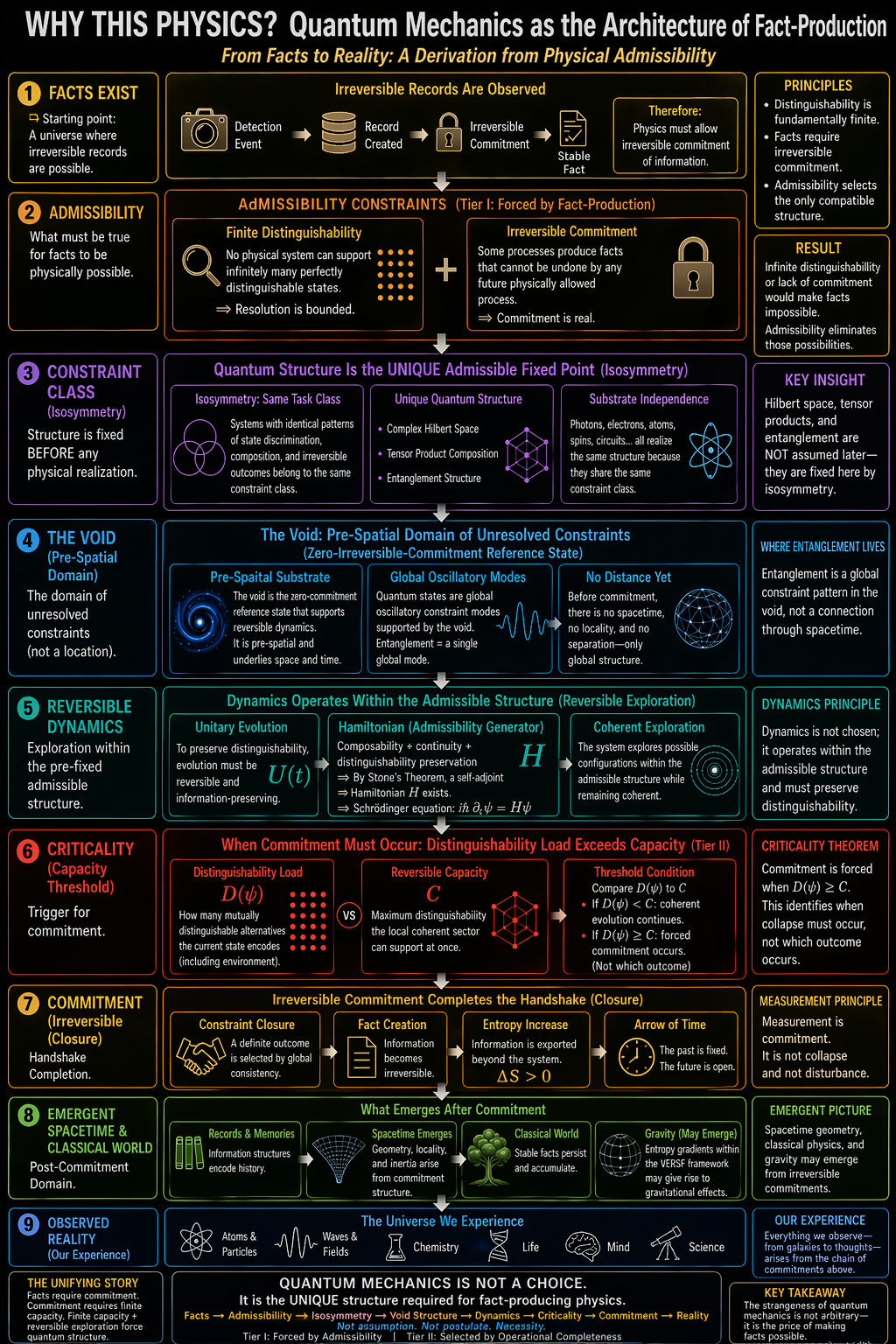
This visual is an attempt to step back from quantum mechanics as a set of rules, and instead ask a more fundamental question: what must be true for a physical world to contain facts at all? We normally start with quantum theory and try to interpret it. Here, the direction is reversed. We start with something simpler and harder to deny—records exist, outcomes persist, information becomes fixed—and then ask what kind of physics could possibly support that. The diagram walks through that logic step by step.
The first key idea is that facts require irreversible commitment. A measurement, a memory, or even a simple recorded value always involves many possible prior states collapsing into a single, stable outcome that cannot be undone. But that immediately imposes a constraint: if a system allowed infinitely fine distinctions, nothing would ever truly be lost—everything could, in principle, be recovered. That would make real facts impossible. So the world must operate under finite distinguishability. Once you accept that, along with the requirement that commitment is genuinely irreversible, a very narrow class of possible physical structures remains.
From there, something striking happens. When you impose these constraints consistently, you don’t get a wide range of candidate theories—you get a single structure. The familiar ingredients of quantum mechanics—Hilbert space, tensor composition, entanglement—are not introduced as assumptions, but emerge as the only admissible way to organize possibilities before they become facts. In this picture, quantum states are not hidden properties of objects, but structured sets of possible outcomes. The “void” layer in the diagram represents this pre-spatial domain, where these possibilities exist as global constraints, not as localized things.
The transition from possibility to reality is handled by the criticality layer. As a system evolves, it explores different configurations while remaining reversible and information-preserving. But this cannot continue indefinitely. When the distinguishability load exceeds the system’s capacity, a threshold is crossed. At that point, commitment is forced. A single outcome is selected, information becomes fixed, entropy increases, and a fact is created. Importantly, this framework does not attempt to determine which outcome occurs—only when a definite outcome must occur. That shift resolves much of the traditional confusion around “collapse.”
After commitment, the familiar world emerges. Spacetime, classical objects, and stable records are not fundamental inputs—they are post-commitment structures, built from accumulated facts. Even features like the arrow of time follow naturally from this process, since commitment is inherently irreversible. In the broader VERSF framework, this same mechanism may also connect to gravitational behavior through entropy gradients, suggesting that quantum theory, thermodynamics, and spacetime geometry are different aspects of a single underlying process.
The core message of the visual is simple but far-reaching:
quantum mechanics is not an arbitrary theory we happened to discover—it is the only structure compatible with a universe in which facts can exist.
What We Can See — and What We Can’t
A central idea in this framework is that not everything we observe belongs to the same layer of reality.
Quantum superposition is not just a theoretical construct—we can observe its effects directly. Interference experiments show that multiple possibilities are present and interacting. We never see a particle as a classical object in two places at once, but we do see the patterns that only superposition can produce.
The important point is this:
When we observe superposition, we are not observing definite events in time—we are observing structure that exists prior to temporal commitment.
Observing the Pre-Temporal
In the VERSF picture, time is not fundamental—it emerges from irreversible commitment, when possibilities become definite and records are formed.
Before that point, systems are not “in time” in the usual sense. They are not evolving through a sequence of definite states. Instead, they exist as structured sets of possibilities—what the framework describes as constraint relations supported by the void.
This is what we access in interference experiments.
We are not observing “two paths happening in time.”
We are observing a system whose structure has not yet been committed into time at all.
That is why superposition looks so strange: it is not a classical process unfolding in time—it is a glimpse of pre-temporal structure.
Why the Void Is Not Directly Observable
The void is the zero-commitment, pre-spatial, pre-temporal domain that supports this structure.
But it is not something we can observe directly.
To observe something as a definite thing is to create a record—to commit it irreversibly. And that is precisely what defines the emergence of time in this framework. So the void, as the regime before commitment, cannot appear as a definite object within observation.
Instead:
- We observe superposition, which reflects pre-temporal structure
- We observe outcomes, which reflect post-commitment reality
- But the void itself remains inferred, not directly seen
How We Know It’s There
We introduce the void not as speculation, but as necessity.
Quantum mechanics shows us:
- global correlations that do not behave like signals
- possibilities that are not localized in spacetime
- outcomes that only become definite at measurement
The simplest way to make sense of this is to recognize that there is a layer of physics:
- before localization
- before temporal ordering
- and before commitment
That is what the void represents.
The Clean Distinction
In this framework:
- Superposition → observation of pre-temporal structure
- Commitment (measurement) → creation of temporal facts
- Void → the pre-temporal, pre-spatial domain that makes both possible
One-line summary
👉 When we observe superposition, we are not seeing events unfolding in time—we are seeing structure that exists before time is fixed by commitment.