What is probability, really?
We use probability all the time.
- A coin has a 50% chance of landing heads
- There’s a 20% chance of rain tomorrow
- A lottery ticket has a tiny chance of winning
In everyday life, probability usually means one of two things:
- Frequency — what happens if you repeat something many times
- Belief — how confident you feel about an outcome
But physics—especially quantum physics—doesn’t quite fit either of these.
The problem in physics
In quantum mechanics, something strange happens.
Before you measure a system, it doesn’t seem to have a definite outcome. It exists in a set of possibilities. But when you measure it, one specific outcome becomes real.
And the theory tells you exactly how likely each outcome is:
The probability is the square of a number called the amplitude.
This is known as the Born rule.
The problem is:
👉 The Born rule is just assumed.
It’s not explained by the rest of the theory.
For nearly a century, physicists have been asking:
Why this rule? Why squared amplitudes? Why not something else?
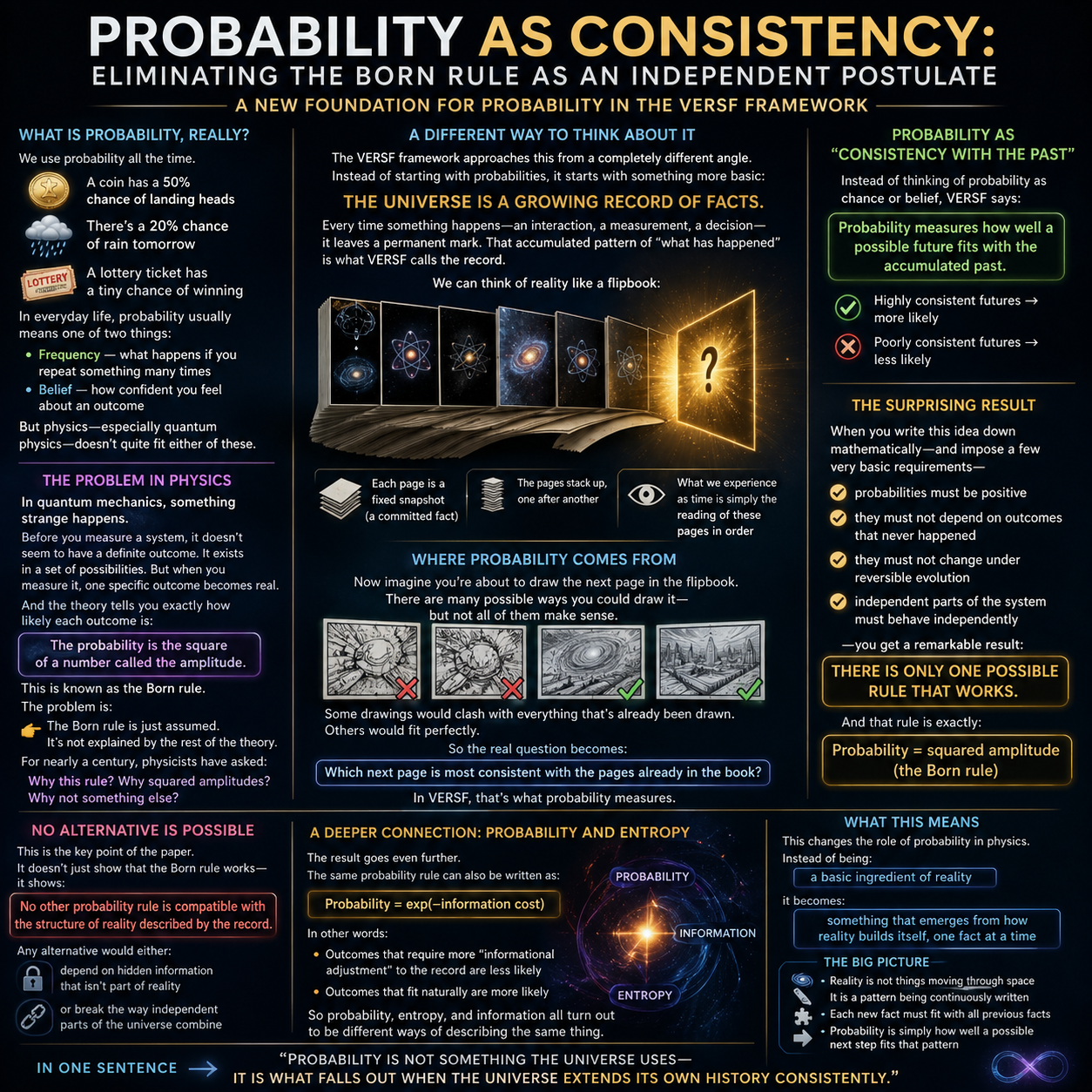
A different way to think about it
The VERSF framework approaches this from a completely different angle.
Instead of starting with probabilities, it starts with something more basic:
The universe is a growing record of facts.
Every time something happens—an interaction, a measurement, a decision—it leaves a permanent mark. That accumulated pattern of “what has happened” is what VERSF calls the record.
We can think of reality like a flipbook:
- Each page is a fixed snapshot (a committed fact)
- The pages stack up, one after another
- What we experience as time is simply the reading of these pages in order
Where probability comes from
Now imagine you’re about to draw the next page in the flipbook.
There are many possible ways you could draw it—but not all of them make sense.
Some drawings would clash with everything that’s already been drawn. Others would fit perfectly.
So the real question becomes:
Which next page is most consistent with the pages already in the book?
In VERSF, that’s what probability measures.
Probability as “consistency with the past”
Instead of thinking of probability as chance or belief, VERSF says:
Probability measures how well a possible future fits with the accumulated past.
- Highly consistent futures → more likely
- Poorly consistent futures → less likely
The surprising result
When you write this idea down mathematically—and impose a few very basic requirements—
- probabilities must be positive
- they must not depend on outcomes that never happened
- they must not change under reversible evolution
- independent parts of the system must behave independently
—you get a remarkable result:
There is only one possible rule that works.
And that rule is exactly:
Probability = squared amplitude (the Born rule)
No alternative is possible
This is the key point of the paper.
It doesn’t just show that the Born rule works—it shows:
No other probability rule is compatible with the structure of reality described by the record.
Any alternative would either:
- depend on hidden information that isn’t part of reality
- or break the way independent parts of the universe combine
A deeper connection: probability and entropy
The result goes even further.
The same probability rule can also be written as:
Probability = exp(−information cost)
In other words:
- Outcomes that require more “informational adjustment” to the record are less likely
- Outcomes that fit naturally are more likely
So probability, entropy, and information all turn out to be different ways of describing the same thing.
What this means
This changes the role of probability in physics.
Instead of being:
- a basic ingredient of reality
it becomes:
something that emerges from how reality builds itself, one fact at a time
The big picture
In this view:
- Reality is not things moving through space
- It is a pattern being continuously written
- Each new fact must fit with all previous facts
- Probability is simply how well a possible next step fits that pattern
In one sentence
Probability is not something the universe uses—
it is what falls out when the universe extends its own history consistently.