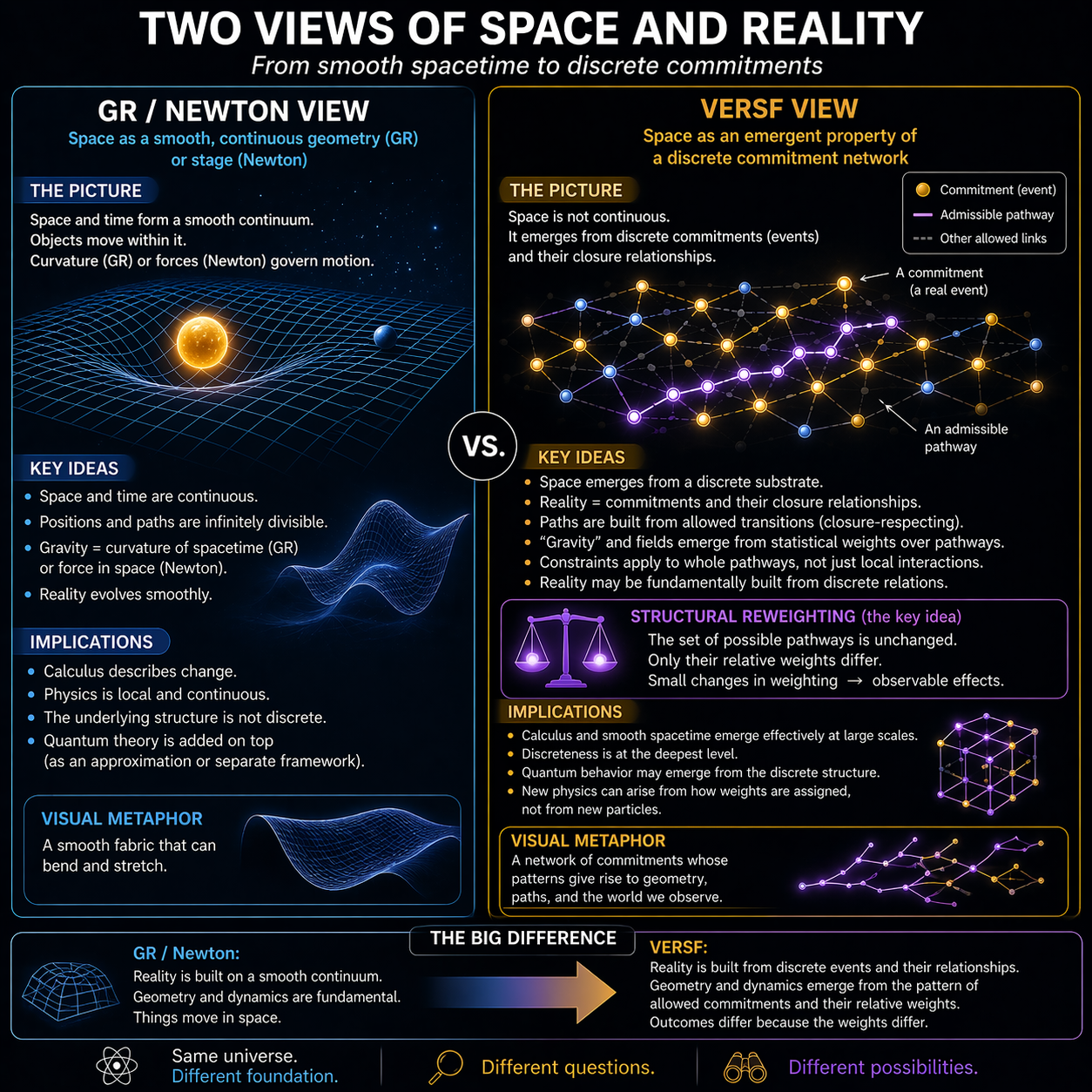
In the classical view of physics—refined through Newton and then Einstein—space and time form a smooth, continuous structure. In Newton’s picture, space is a kind of stage where objects move and forces act. In Einstein’s General Relativity, that stage becomes dynamic: mass and energy curve spacetime itself, and that curvature is what we experience as gravity. But in both cases, space and time are treated as fundamental. Everything happens within this continuous geometric framework.
VERSF starts from a different place. Instead of assuming space and time exist at the deepest level, it proposes that they emerge from something more basic: discrete “commitments” and the relationships between them. In this view, what we perceive as space is actually a large-scale description of an underlying network of events. Geometry isn’t fundamental—it’s a compressed summary of how those events relate to each other. The smooth spacetime of General Relativity still appears, but only as an effective, large-scale approximation.
Why This Difference Matters
This shift changes the role of physics quite dramatically. In the classical and relativistic view, you describe how objects move through space. In VERSF, you describe how patterns of relationships evolve, and space is what that pattern looks like when it becomes smooth and coherent. Even concepts like gravity can be reinterpreted—not as curvature of a pre-existing geometry, but as the result of how the underlying structure weights different possible pathways.
The key idea is subtle but powerful: the possible ways a system can evolve don’t necessarily change—but their relative importance does. Small changes in how these possibilities are weighted can lead to observable effects, potentially explaining anomalies that are otherwise attributed to new particles or forces. In this sense, VERSF doesn’t replace General Relativity—it reframes it as an emergent description of a deeper, discrete layer of reality.