Physics usually starts by assuming a few big ideas.
We’re told that matter is made of quantum states.
That forces come from fields like electromagnetism.
And that gravity is the curvature of spacetime.
These ideas work incredibly well — but they’re normally introduced as separate starting points. Three different “first principles” that somehow fit together.
But what if they aren’t separate at all?
What if all three come from something deeper — something so basic that it has to be true in any universe where physics is even possible?
That’s the question behind a series of papers in the VERSF programme. And taken together, they suggest something quite striking:
The structure of physics might not be chosen — it might be forced.
Core Idea (simple explanation)
The starting point is surprisingly simple:
Physics deals in facts.
A “fact” is just something definite happening — a particle detected, a measurement made, a state chosen from possibilities.
But if you think about it carefully, this isn’t trivial.
Without definite outcomes:
- there is no time (nothing changes in a meaningful way)
- there are no laws (nothing definite to predict or test)
This is the key insight of the first paper:
Facts aren’t something physics produces — they’re something physics requires.
From Facts to Constraints
Once you accept that physics must deal with definite, recordable outcomes, something powerful happens.
To do science at all, outcomes must be:
- recordable
- repeatable
- comparable between observers
That sounds obvious — but it turns out these simple requirements place very strong constraints on what physics can look like.
The second paper shows:
Any theory that produces real experimental results must obey a small set of structural rules.
In other words:
You don’t get to choose the structure of physics freely — it’s constrained by what it means to measure anything at all.
From Constraints to Structure
Now comes the surprising part.
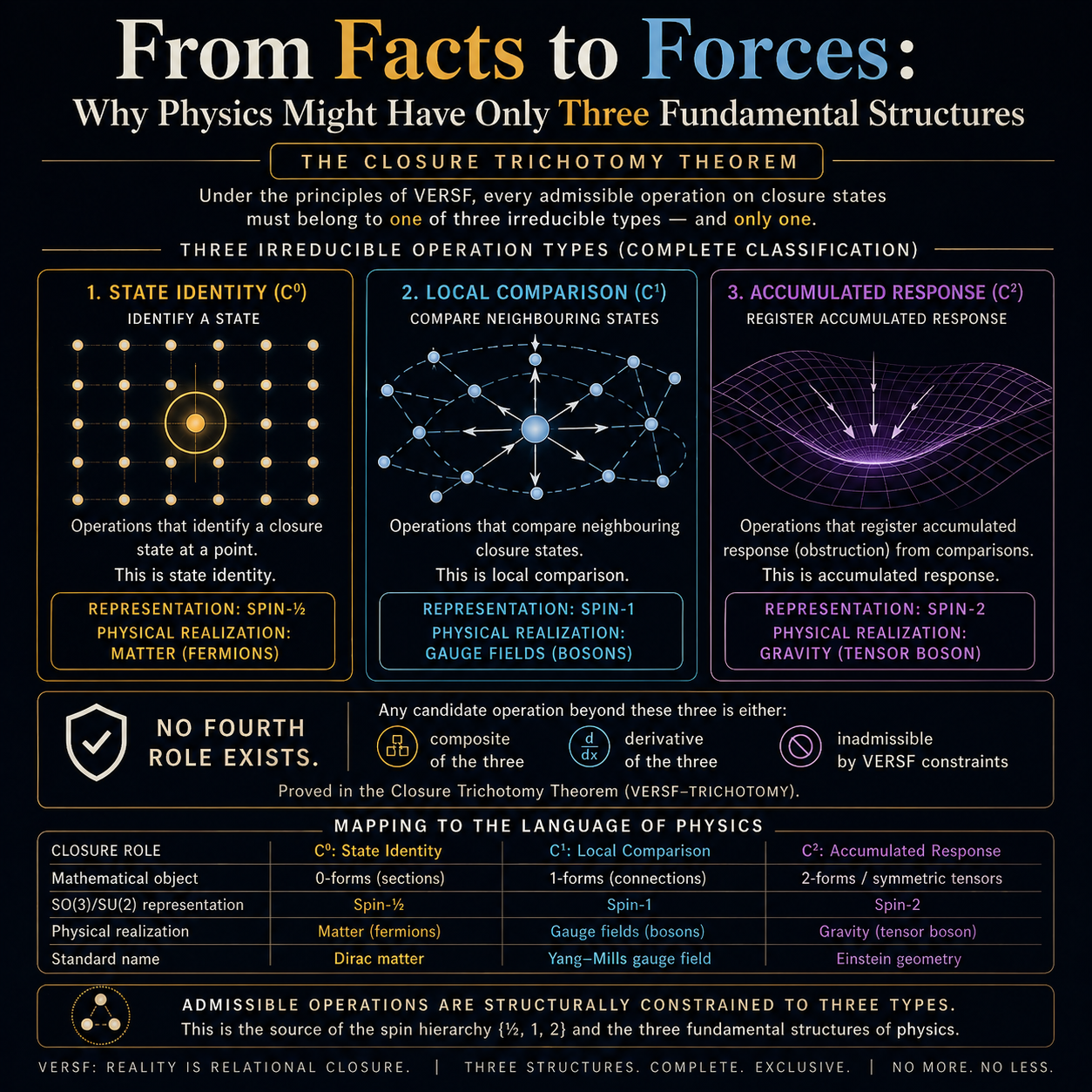
If you follow those constraints through carefully, you find that physical operations fall into just three fundamental types:
- Identifying a state (what something is)
- Comparing states across space (how things relate)
- Responding to accumulated changes (how reality reacts over time)
The third paper proves that this isn’t just a convenient classification:
There are exactly three types of fundamental operations — no more.
And this is where physics appears
Once you map those three roles into mathematics, something remarkable happens:
| Role | What it becomes | What we see in physics |
|---|---|---|
| Identify a state | quantum state structure | matter (spin-½ particles) |
| Compare states | connection across space | forces (gauge fields) |
| Respond to accumulation | geometric response | gravity |
Spin (matter)
The first layer shows that if states are defined properly, you must get the strange “spin-½” behaviour seen in electrons:
rotating something once (360°) doesn’t bring it back — you need 720°.
Forces (gauge fields)
The second layer shows that if you try to compare quantum states across space, you are forced to introduce a field — exactly like electromagnetism:
the field isn’t added — it’s required just to make comparisons consistent.
Gravity
The third layer shows that when changes accumulate, the system must respond through a structure that looks like spacetime geometry:
this leads directly to something like Einstein’s equations.
The Big Picture
Put it all together, and you get a chain like this:
Facts must exist
    ↓
Constraints on what can be measured
    ↓
Only three types of operations possible
    ↓
Three layers of physics:
    • Matter (spin-½)
    • Forces (spin-1)
    • Gravity (spin-2)
Why this matters
This doesn’t change the equations of physics.
It changes something deeper:
where those equations come from
Instead of:
- three independent ideas (quantum, gauge, gravity)
you get:
one underlying structure producing all three
Closing
The direction is clear.
Instead of asking:
“Why does physics have this structure?”
the question becomes:
“Could physics have been any other way?”
And the answer these papers suggest is:
Maybe not.
If physics is about facts — and facts require certain structures — then the familiar building blocks of reality might not be arbitrary at all.
They might be:
the only way a universe can make sense of itself.