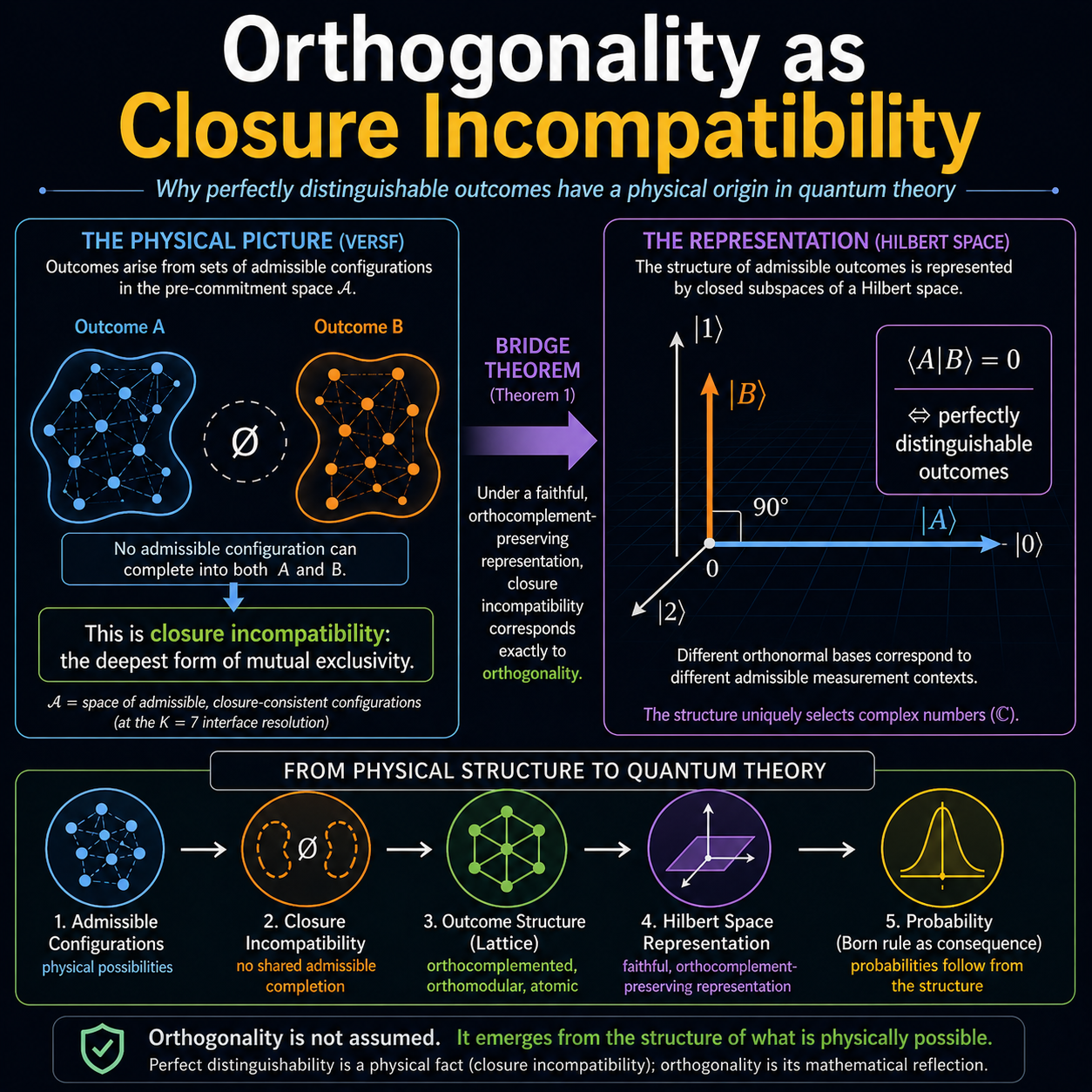
We’re used to thinking of quantum mechanics as strange and abstract. One of its most basic ideas is that two outcomes can be perfectly distinguishable—they never get mixed up. In the math, this shows up as something called orthogonality: two possibilities are “at right angles” to each other in a kind of invisible space. Physicists usually just accept this as part of the rules. But that leaves a deeper question unanswered:
Why should perfect distinguishability look like perpendicular directions in a mathematical space at all?
This paper takes a step back and answers that question from a more physical starting point.
In the VERSF framework, reality isn’t built from waves or particles first—it’s built from facts. A fact is what happens when one possibility becomes real and all the others are ruled out. Before that moment, there’s a set of allowed possibilities—what we call admissible configurations.
Now here’s the key idea:
👉 Two outcomes are truly incompatible if there is no possible underlying configuration that could lead to both of them.
That’s what we call closure incompatibility. It’s a very concrete idea: it’s not about geometry or math—it’s about what is physically possible.
What the paper shows is something quite surprising:
The familiar quantum idea of orthogonality is just the mathematical reflection of this deeper physical fact.
In other words, when two outcomes are “perpendicular” in quantum theory, what that really means is:
👉 There is no physically allowed way for them to arise from the same underlying configuration.
The geometry comes after the physics—not the other way around.
From there, everything else starts to make more sense. The mathematical structure physicists use—Hilbert space, vectors, inner products—isn’t just invented because it works. It turns out to be the natural way to represent how these admissible possibilities fit together.
And once you have that structure, the famous Born rule—the rule that tells you the probabilities of outcomes—falls out as a consequence. It’s not something you have to add in by hand. It’s what you get when you consistently assign weights to possibilities that can’t overlap.
Another way to think about it is this:
- Physics tells you which possibilities are allowed
- Closure tells you which possibilities can coexist
- And the math of quantum mechanics is just the cleanest way to keep track of that structure
So instead of saying:
“Quantum mechanics assumes orthogonality”
we can now say:
“Orthogonality is what incompatibility looks like when you translate physical structure into mathematics.”
The broader picture is that this is one piece of a bigger effort: rebuilding quantum theory from the ground up, starting with simple physical ideas like distinguishability and irreversible events, rather than abstract mathematical postulates.
This paper doesn’t try to do everything. What it does is very specific:
👉 It explains what orthogonality actually means physically.
And once you see that clearly, a lot of the mystery starts to lift.