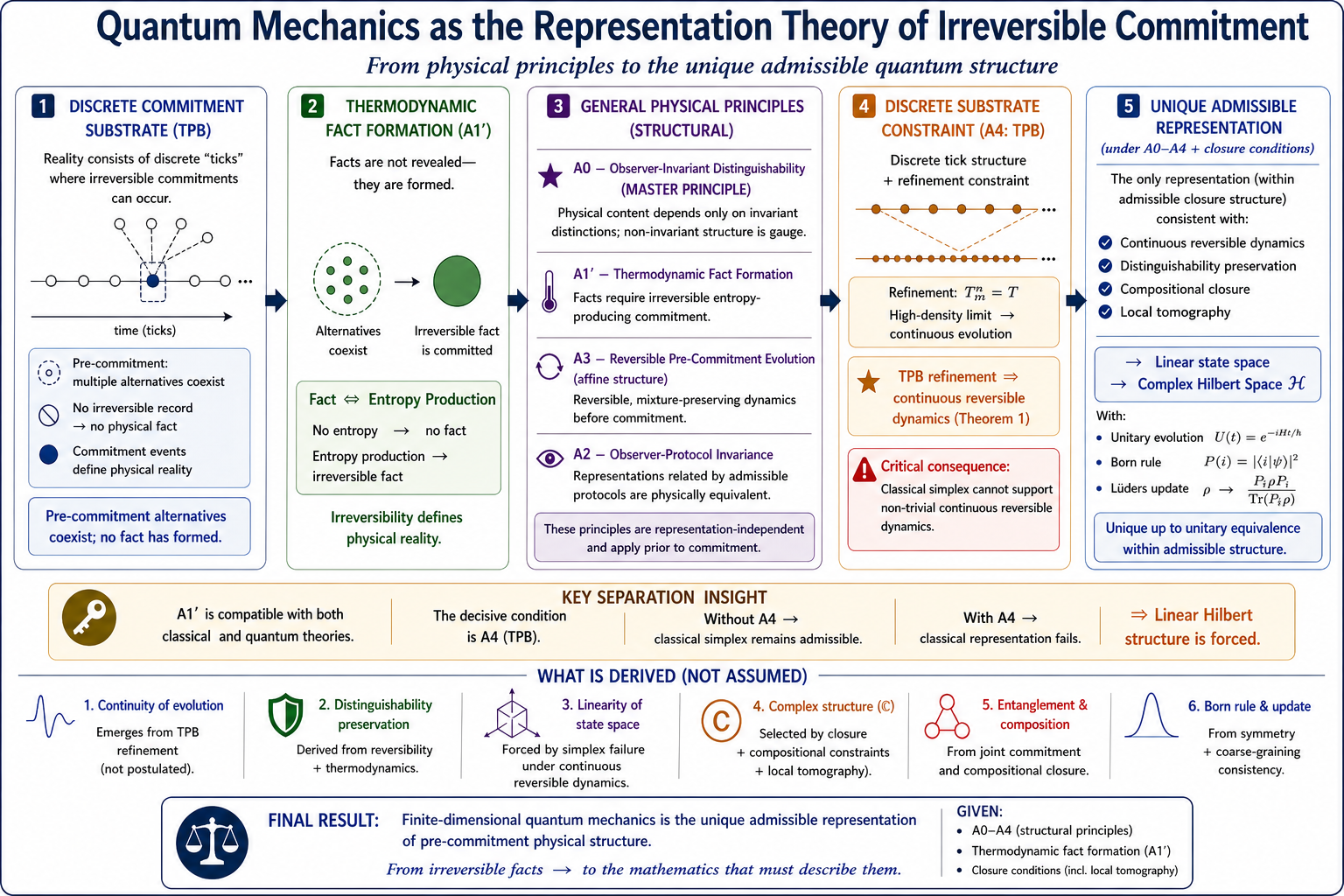
What makes this paper significant is not just that it reproduces the formalism of quantum mechanics, but where it starts from. Most existing derivations of quantum theory begin by assuming structures that already look recognisably quantum—continuous transformations between states, preservation of probabilities, or symmetry principles that effectively encode Hilbert space geometry from the outset. These approaches are valuable, but they don’t fully answer the deeper question: why does nature have those properties in the first place?
This paper takes a different route. It does not begin with quantum structure. Instead, it starts from a set of more general physical principles about how reality itself is formed—most importantly, the idea that facts only come into existence through irreversible, entropy-producing events. That principle, grounded in thermodynamics rather than quantum theory, applies just as well to classical systems as it does to quantum ones. On its own, it does not pick out quantum mechanics.
What changes the picture is the addition of a structural constraint: the existence of a discrete underlying substrate of “commitment events” (the TPB framework). When these two ingredients are combined—thermodynamic fact formation and a discrete-but-refinable substrate—the familiar features of quantum mechanics begin to emerge. Continuity of evolution is no longer assumed but arises as a high-density limit. Preservation of distinguishability is no longer postulated but follows from reversibility and the thermodynamic cost of information. Even the structure of the state space is not chosen for convenience but is forced by the inability of classical probability theory to support the resulting dynamics.
In that sense, the paper doesn’t reconstruct quantum mechanics so much as it explains why its usual axioms exist at all. It shows that the mathematical machinery of Hilbert spaces, unitary evolution, and the Born rule is not an arbitrary starting point, but the unique stable representation of a deeper set of physical constraints. Quantum mechanics, on this view, is what reality looks like when you describe it from inside a world where facts are formed irreversibly on a discrete substrate.
That shift in starting point is the real contribution. Instead of assuming quantum theory and exploring its consequences, the paper attempts to derive the need for quantum theory from more primitive ideas. Whether or not one ultimately accepts the underlying framework, it reframes the question in a way that goes beyond standard reconstruction programmes—and that is where its significance lies.