What if the Born rule isn’t a guess… but unavoidable?
In quantum physics, there’s a strange and uncomfortable fact that has been sitting at the heart of the theory for nearly a century.
When you measure something—an electron’s position, a photon’s path—the outcome isn’t determined in advance. Instead, nature seems to “choose” one possibility from many. And while we can’t predict exactly which outcome will occur, we can predict the probabilities.
Those probabilities follow a very specific rule:
you take a quantity called an amplitude, and you square it.
That’s the Born rule.
The problem is: in standard physics, this rule is simply assumed. It works beautifully—but no one has ever been fully satisfied with why it should be true.
A different way to look at the problem
Most attempts to explain the Born rule try to replace it with something else:
- Maybe it comes from symmetry
- Maybe from information theory
- Maybe from decision theory
- Maybe from geometry
Each approach gives a derivation—but each also introduces a new assumption that people argue about.
So the problem never really goes away. It just moves.
What if the answer isn’t one derivation—but five?
This paper takes a completely different approach.
Instead of trying to find one perfect explanation, it looks at something more powerful:
What if multiple, completely different ways of thinking all lead to the same rule?
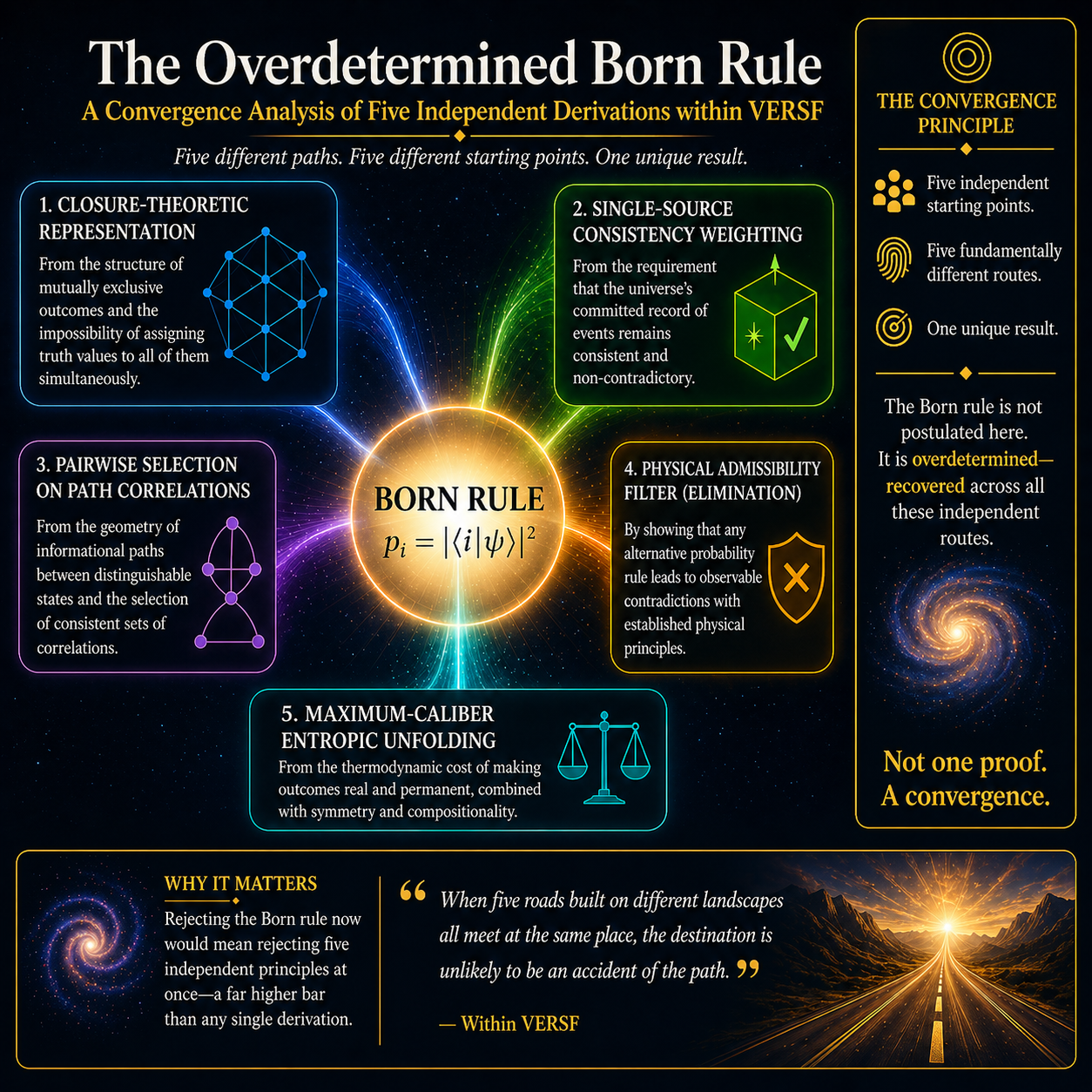
Within the VERSF framework, the Born rule has now been derived in five independent ways, each starting from a different idea:
- From how mutually exclusive outcomes are structured
- From how the universe keeps a consistent record of events
- From the geometry of possible paths between states
- From ruling out alternative probability rules as physically impossible
- From the thermodynamic cost of making outcomes real
These are not variations of the same argument. They are genuinely different routes—different starting points, different logic, different mathematics.
And yet…
They all arrive at exactly the same rule: the Born rule.
Why that matters
In science, there’s a special kind of confidence that comes not from one explanation—but from many.
Think about how we know certain physical constants. We didn’t trust a single experiment—we trusted the fact that many different experiments, based on different ideas, all gave the same answer.
This paper argues that something similar is happening here.
It’s not that any one derivation of the Born rule is perfect.
It’s that:
to reject the rule, you would now have to show that all five completely different ways of deriving it fail at the same time.
And that’s a much harder thing to believe.
From assumption to structure
The deeper shift is this:
Instead of treating the Born rule as something we put into physics…
it starts to look like something that keeps coming out of it, no matter how you approach the problem.
That’s what the paper calls overdetermination.
Not one path to the answer—but many.
Not a fragile assumption—but a stable structure.
The big idea
If you had to boil the whole paper down to one sentence, it would be this:
The Born rule isn’t just derived once—it’s recovered again and again from completely different directions.
And when that happens in physics, it usually means you’re not looking at a coincidence.
You’re looking at something deeper.